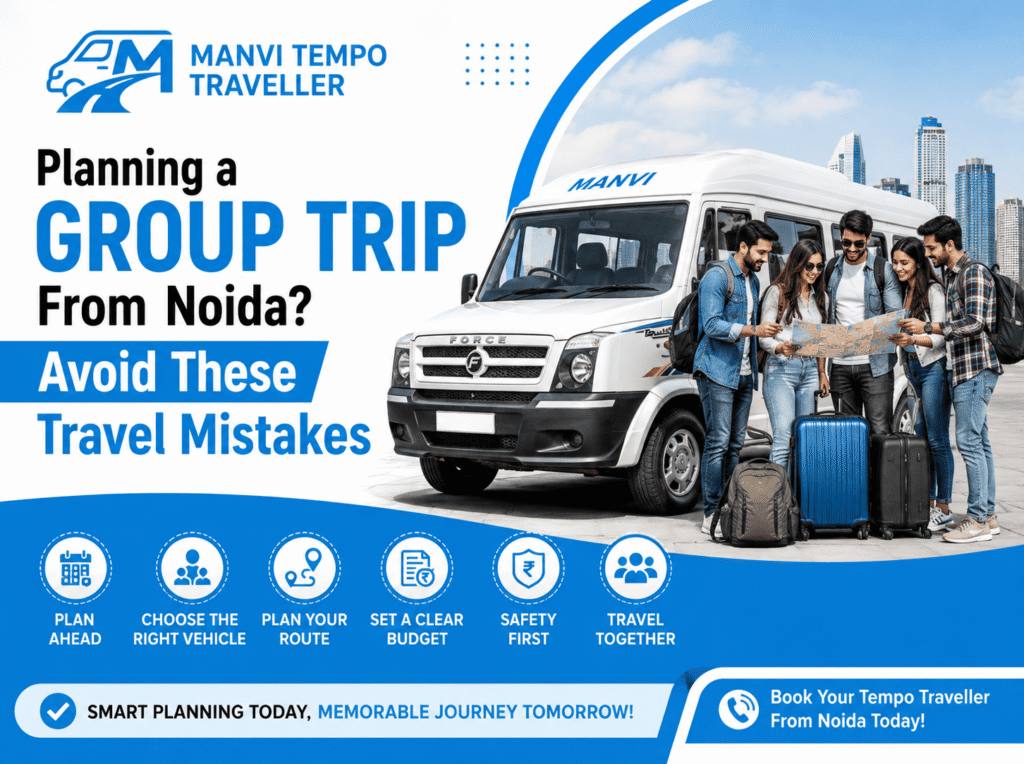

Every group trip out of Noida ultimately comes down to two decisions that matter more than the destination itself: how smartly you book the vehicle, and how safely you travel in it. Get the booking wrong, and you overpay or end up with a cramped, poorly maintained vehicle. Get the safety checks wrong, and comfort stops mattering the moment something goes wrong on the highway.
This checklist is built around exactly that split – smart booking decisions before you pay a rupee, and safety checks before you let your group step into the vehicle. Whether you’re planning a family weekend getaway, a corporate outing, a wedding transport plan, or a pilgrimage trip, running through both halves of this list will save you money, time, and genuine risk.
Why Groups in Noida Increasingly Choose Tempo Travellers Over Multiple Cars
For groups larger than five or six people, splitting into multiple cars almost always creates more problems than it solves – separate drivers to coordinate with, staggered arrival times, higher combined fuel and toll costs, and the simple frustration of a group that can’t talk, plan, or enjoy the journey together. A single tempo traveller solves all of this in one booking: everyone leaves together, arrives together, and shares one clear point of contact for the entire trip.
This is exactly why tempo travellers have become the default choice for family weekend getaways, office outings, wedding guest transport, and pilgrimage groups traveling out of Noida. But that convenience only holds up if the booking and safety fundamentals are handled properly – which is exactly what both halves of this checklist are designed to cover.
Part 1: Book Smart – What to Check Before You Confirm
1. Match the Vehicle to Your Actual Group Size
Start with a firm headcount, not an estimate. Tempo travellers in Noida typically come in 9, 12, 16, 17, 20, and 26-seater configurations. Booking too small means an uncomfortable, cramped ride; booking too large means paying for empty seats. A smart rule: add 1-2 seats beyond your exact headcount so there’s room to stretch and space for luggage on longer routes.
2. Compare Per-KM Pricing Against Fixed Packages
Outstation bookings are usually charged per kilometre, generally between ₹22 and ₹36 depending on seating capacity, with a minimum daily running requirement of roughly 250-300 km. Local city rentals typically run on hourly-and-kilometre package slabs instead. If your itinerary is still flexible, per-km pricing works better; if your route and stops are already fixed, a package rate protects you from a fluctuating final bill.
3. Insist on a Fully Itemized Written Quote
A single lump-sum number is where most disputes start. Ask for a complete, full breakdown covering base fare, driver allowance, night halt charges, tolls, parking, state tax for interstate routes, and GST. Booking smart means never agreeing to a number you can’t explain to your group afterward.
4. Read the Inclusions and Exclusions Line by Line
Fuel, driver charges, and the base kilometre allowance are usually included in the quoted price. Extra-kilometre charges, waiting time beyond a free limit, tolls, and parking are usually not. Get this distinction confirmed in writing before you pay any advance – this is where “hidden charges” tend to surface on the final day.
5. Book Early, Especially in Peak Travel Windows
Reserve your vehicle 3-5 days ahead for a standard weekend trip, and 2-3 weeks ahead during October-February, summer school holidays, and wedding season, when reliable operators and experienced drivers get booked out across Noida and the wider NCR fast. Booking smart often just means booking early.
6. Check the Cancellation and Refund Terms Upfront
Group plans shift more often than solo ones. Ask exactly how many hours of notice are needed for a full or partial refund – many operators charge minimal fees for cancellations made 72 or more hours in advance – and how that changes closer to the travel date.
7. Verify the Operator’s Reputation, Not Just the Price
The cheapest quote isn’t automatically the smartest booking. Check reviews, ask for references from past group bookings, and confirm the operator has a verifiable address and consistent contact history. A slightly higher price from a reliable operator is almost always the smarter long-term choice.
8. Confirm Pickup Point, Timing, and Payment Terms in Writing
Share your exact sector and address for doorstep pickup, confirm the reporting time, and get written confirmation of the advance paid – typically 20-30% of the total – along with the balance payment terms. A message or email record protects everyone involved.
Part 2: Travel Safe – What to Check Before You Get In
1. Verify the Driver’s License and Route Experience
A valid, current license is the baseline – but for group safety, route familiarity matters just as much. Ask how long the driver has handled outstation trips and whether they’ve driven your specific route before, particularly for hill roads to Nainital, Mussoorie, or Lansdowne. A driver who has covered a route dozens of times will handle unexpected traffic, weather changes, or road diversions far more calmly than one encountering it for the first time.
2. Inspect the Vehicle Before You Load Up
Check that tyres are in good condition, brakes feel responsive, air conditioning works, and every seat has a functional seat belt. A quick walk-around before boarding takes two minutes and can flag an issue before it becomes a highway problem.
3. Confirm Valid Insurance and Permit Documentation
Ask to see proof of current vehicle insurance, and if your trip crosses state lines – say, from Delhi to Rajasthan, Uttarakhand, or Himachal Pradesh – confirm the operator holds a valid all-India tourist permit. This avoids delays or fines at state border checkpoints that can derail a tight group schedule.
4. Ask About GPS Tracking and Emergency Contacts
A reliable operator should offer GPS tracking on the vehicle and a reachable emergency contact number beyond just the driver’s personal phone. For a family or large group traveling several hours from home, this isn’t optional – it’s a basic safety net.
5. Check for a First-Aid Kit and Basic Emergency Supplies
A stocked first-aid kit, a spare tyre, and basic breakdown tools should be considered standard on any tempo traveller taking a longer outstation route. Ask about this clearly before you travel, not after something happens on the road.
6. Clarify the Driver’s Policy on Night Driving
Hill roads especially should be avoided after dark wherever possible. Ask the operator or driver directly about their approach to night driving on your specific route, and plan departure times that avoid unnecessary risk on unfamiliar roads.
7. Share Your Itinerary and Emergency Plan with the Group
Before departure, make sure at least one or two people beyond the driver know the full route, planned stops, and expected arrival time. For longer trips, share this with someone staying back home too – a simple habit that costs nothing and adds a real layer of safety.
8. Confirm Luggage Is Secured, Not Just Loaded
Loose luggage sitting in the aisle or overhead rack can become a real hazard during sudden braking. Make sure bags are properly stored in the designated luggage area before the vehicle starts moving, especially for groups traveling with heavier bags for multi-day trips.
Choosing the Right Seating Capacity
Getting the vehicle size right is both a booking-smart and travel-safe decision – an overcrowded vehicle is a safety risk, not just a comfort issue.
- 9-seater: Small families or close friend groups on short local trips.
- 12-seater: Medium families or small office teams on standard weekend trips.
- 16 / 17-seater: Larger families, group pilgrimages, and extended outstation or hill routes.
- 20-seater: Office tours, medium wedding groups, and school outings.
- 26-seater and above: Large weddings, corporate events, and big college trips.
If your group crosses roughly 17-18 people, compare a larger tempo traveller against a minibus – beyond that size, a minibus is often the more practical and cost-efficient choice.
Red Flags That Should Make You Pause
- No written quotation, or resistance when you ask for one broken down by charge type.
- Vague or dismissive answers about the driver’s experience or the vehicle’s service history.
- No clear answer on insurance coverage when you ask directly.
- Pressure to pay the full amount upfront rather than a standard advance.
- No verifiable reviews, address, or past booking references.
Any one of these is worth noting; more than one is a clear signal to book elsewhere, regardless of how competitive the price looks.
Smart Ways to Save Without Cutting Safety Corners
- Book only the seats your group actually needs – right-sizing saves more than negotiating.
- Ask about discounts on round-trip or multi-day bookings.
- Compare per-km and package pricing for your specific route before deciding.
- Book early to avoid peak-season surge pricing on popular dates and routes.
- Read the full rental agreement before confirming, so nothing changes at final billing.
None of these shortcuts should ever come at the cost of driver experience, vehicle condition, or valid documentation – that’s where “smart” and “safe” have to stay non-negotiable together.
Final Thoughts
Booking smart and traveling safe aren’t two separate goals – they’re two halves of the same decision. A well-priced booking with an inexperienced driver isn’t a good deal, and a safe vehicle with a confusing, hidden-cost quotation isn’t a smart one either. Running through both checklists before you confirm anything is what actually protects your group’s time, money, and safety.
At Manvi Tempo Traveller, every booking in Noida comes with a transparent, itemized quotation, well-maintained and regularly serviced vehicles, and experienced drivers who know both the local sectors and the outstation highways to Agra, Jaipur, Rishikesh, and the hill stations beyond. Whether it’s a family trip, a corporate outing, or a wedding group, we handle both halves of the checklist so you don’t have to.
Contact Manvi Tempo Traveller today for a clear, no-hidden-cost quote and a well-maintained vehicle you can genuinely trust for the journey ahead.
You can also discover our Extensive Oustation Tour and Travels Packages:
👉 Noida to Jim Corbett National Park
Frequently Asked Questions
What’s the difference between booking smart and traveling safe?
Booking smart is about the paperwork and pricing – getting a clear quote, the right vehicle size, and fair terms. Traveling safe is about what happens once you’re on the road – driver experience, vehicle condition, and emergency preparedness. A good trip needs both.
How early should I book a tempo traveller in Noida?
3-5 days ahead for a normal trip, and 2-3 weeks ahead during peak season – October to February, summer holidays, and wedding season.
What safety documents should I ask to see before the trip?
Ask for the driver’s license, the vehicle’s insurance certificate, and – for interstate travel – proof of a valid all-India tourist permit.
Is it safe to travel on hill routes at night?
It’s best avoided wherever possible. Confirm the driver’s approach to night driving on hill roads in advance and plan your departure time accordingly.
How many seats should I book for my group?
Book 1-2 seats more than your exact headcount for comfort and luggage space, especially on longer outstation trips.
Should I choose the cheapest quote available?
Not automatically. Compare the price against the operator’s reputation, vehicle condition, and driver experience – the lowest quote isn’t always the smartest or safest choice.
Can I request a specific driver or vehicle for my group?
Many operators accommodate this if you ask at the time of booking, especially for repeat customers or larger groups with specific comfort needs. It’s worth requesting upfront rather than assuming it’ll be arranged automatically.
What should I do if the vehicle that arrives doesn’t match what was promised?
Raise it immediately with the operator before departure, referencing your written quote and confirmation. This is exactly why getting everything in writing beforehand matters – it gives you something concrete to point back to.