
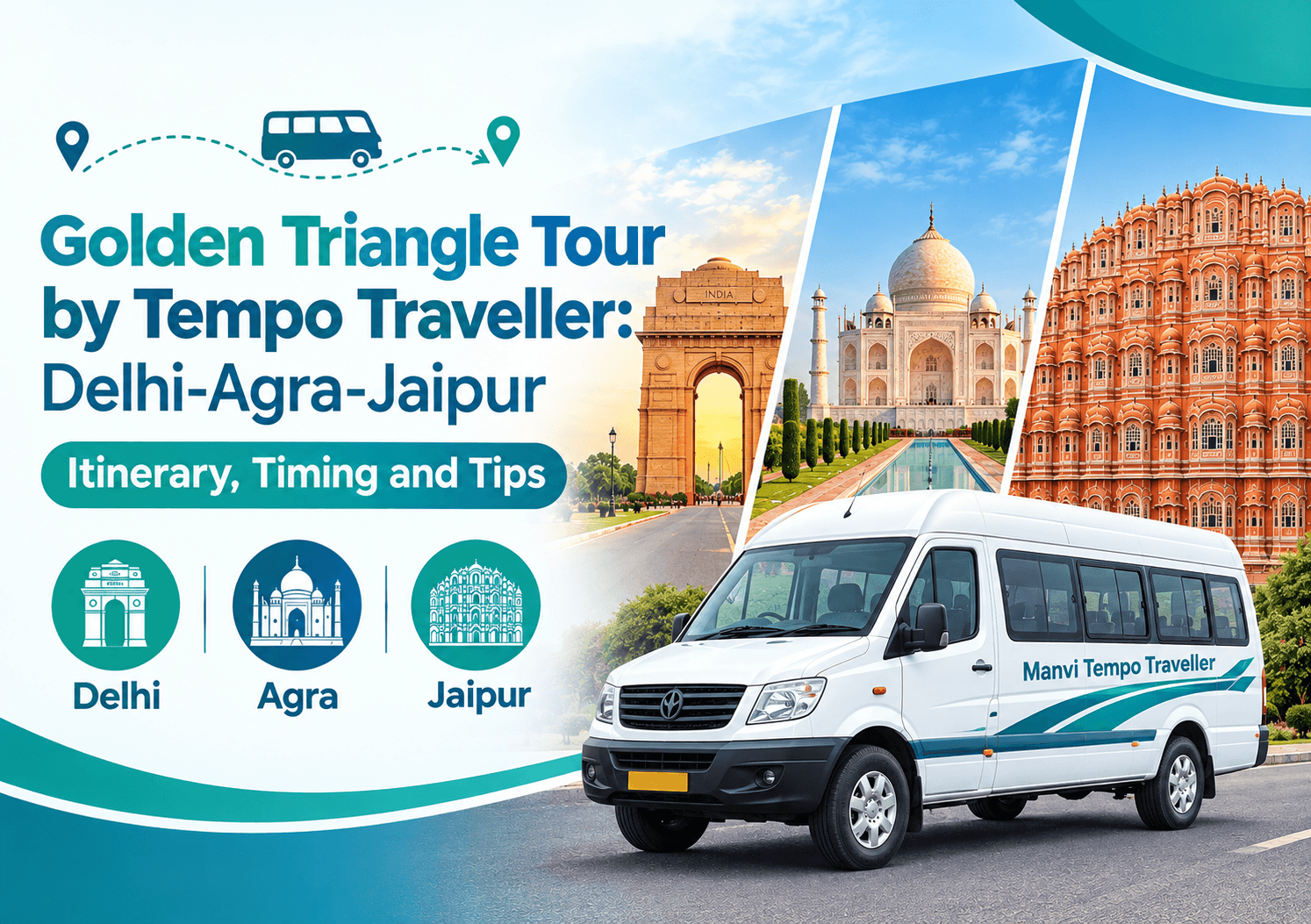
If there is one road trip that introduces first-time visitors to India’s history, architecture and food, it is the Golden Triangle. Three cities, Delhi, Agra and Jaipur, sit roughly 230 to 280 km apart. Together they hold Mughal monuments, Rajput palaces, busy bazaars and some of the best street food in the country.
For a group, the way you travel matters as much as where you go. Three or four separate cabs, a bus with fixed stops, or a train schedule you must plan around can turn a relaxing holiday into a logistics exercise. A tempo traveller solves most of this. Your whole group rides together, your luggage stays in one place, and you decide when to stop for chai, photos or an unplanned detour.d
This guide covers everything you need to plan a Golden Triangle tour by tempo traveller: the route, a day-wise itinerary, the best time to go, how long each stretch takes, what to see, what to eat, and practical tips.
What Is the Golden Triangle?
The Golden Triangle is a classic tourist circuit in North India connecting three cities:
• Delhi, the capital, mixing Mughal monuments, colonial boulevards and busy old-city markets.
• Agra, home to the Taj Mahal, Agra Fort and the abandoned Mughal city of Fatehpur Sikri.
• Jaipur, the “Pink City” of Rajasthan, known for forts, palaces, bazaars and handicrafts.
When you draw the three cities on a map, they form a triangle, which is where the name comes from. The loop is popular because the distances are manageable, the roads are good, and each city feels distinctly different from the others.
Why Choose a Tempo Traveller for the Golden Triangle?
A tempo traveller is a spacious, air-conditioned passenger van that usually comes in 9, 12, 17 and larger seating configurations, depending on the operator. For this route, it has several advantages.
1. The whole group travels together. Families, friends, college groups and colleagues can talk, play music, take group photos and share snacks without being split across vehicles.
2. Comfort over long drives. Pushback seats, air conditioning and decent legroom make the 4 to 6 hour stretches between cities easier, especially for children and senior citizens.
3. Flexible stops. Unlike a bus or train, you control the schedule. Want to stop for breakfast at a highway dhaba, visit a roadside stepwell or spend extra time at a market? You can.
4. Space for luggage and shopping. Jaipur is a shopping city. Textiles, jewellery, blue pottery and handicrafts add up quickly, and a tempo traveller gives you room to carry them.
5. Cost sharing. For a group of 8 to 12 people, one vehicle is often more economical than several cabs. (We cover cost factors in a later section.)
6. A local driver. An experienced driver knows the expressway exits, parking areas near monuments and the best times to avoid traffic.
Golden Triangle Route and Distances
The standard loop is Delhi → Agra → Jaipur → Delhi. Approximate road distances and driving times are below. Actual times depend on traffic, weather and stops.
| Route | Approx. Distance | Approx. Driving Time |
| Delhi to Agra (via Yamuna Expressway) | 230 km | 3.5 to 4.5 hours |
| Agra to Jaipur | 240 km | 4.5 to 5.5 hours |
| Jaipur to Delhi | 270 to 280 km | 5 to 6 hours |
The Delhi-Agra leg is mostly on the Yamuna Expressway, a smooth, wide, access-controlled road. The Agra-Jaipur leg passes through towns and highway stretches, so it takes longer than the distance suggests. The Jaipur-Delhi return uses the national highway and can slow down near toll plazas and urban entry points.
Best Time to Do the Golden Triangle Tour
October to March (Best). Days are pleasant, ideal for walking around forts and monuments. December and January mornings can be foggy and cold, which sometimes slows down road travel, so start a little later on those days.
April to June (Hot). Temperatures in Agra and Jaipur can be very high in the afternoon. The tour is still possible with an air-conditioned vehicle, but plan sightseeing for early morning and late afternoon and rest during midday.
July to September (Monsoon). Rains turn the landscape green and crowds are smaller, but humidity is high and showers can disrupt outdoor sightseeing. Carry rain gear and keep some flexibility in the schedule.
A quick tip on festivals: Diwali, Holi and the winter holiday season bring more visitors and higher demand for vehicles and hotels. Book your tempo traveller and stay well in advance for these periods.
Recommended Itineraries
You can do the Golden Triangle in as little as 3 days or stretch it comfortably over 5 to 6. Here are the two most popular options for groups.
Option A: 4 Days / 3 Nights (Balanced Plan)
Day 1: Delhi Sightseeing
Start your tour with a Delhi city day. Your tempo traveller can pick up the group from your home, hotel or airport.
• India Gate and Rajpath area: A simple, open space for photos and a short walk.
• Humayun’s Tomb: A beautiful garden tomb that is considered a forerunner of Mughal architecture seen at the Taj Mahal.
• Qutub Minar: A towering historic minaret complex in South Delhi.
• Old Delhi (optional): Jama Masjid, the lanes of Chandni Chowk and a cycle-rickshaw ride. This is best done with a local guide, since the lanes are crowded and parking is limited. Your driver can drop you nearby and wait.
• Evening: Dinner at a restaurant in Connaught Place, Hauz Khas or Old Delhi, depending on what your group enjoys.
Stay overnight in Delhi.
Day 2: Delhi to Agra (Taj Mahal and Agra Fort)
Leave Delhi early, around 6:00 to 7:00 AM. On the Yamuna Expressway you can reach Agra by late morning.
• Agra Fort: A massive red sandstone fort on the Yamuna riverbank, with palaces, courtyards and views of the Taj Mahal in the distance.
• Taj Mahal: Visit in the late afternoon or, if your schedule allows, at sunrise on the next day. Note that the Taj Mahal is closed on Fridays, so plan your days accordingly.
• Mehtab Bagh (optional): A garden across the river that offers a calm view of the Taj Mahal, good for sunset photos.
• Local shopping: Agra is known for marble inlay work, leather goods and its sweet, petha.
Stay overnight in Agra.
View Our 👉 Travel tempo traveller Services for Agra
Day 3: Agra to Jaipur via Fatehpur Sikri
• Early morning (optional): If you want a sunrise Taj Mahal visit, go very early, before the crowds. Return to the hotel for breakfast.
• Fatehpur Sikri: About 40 km from Agra, this red sandstone city was built by Emperor Akbar and abandoned within a few decades. It is on the way to Jaipur, so it fits neatly into the route.
• Abhaneri (optional stop): Chand Baori is one of India’s most striking stepwells, with thousands of symmetrical steps. It is a detour, so check your timing before adding it.
• Arrive in Jaipur by evening. Spend time in the local bazaars (Johari Bazaar, Bapu Bazaar) if energy permits. Try a traditional Rajasthani thali for dinner.
Stay overnight in Jaipur.
Day 4: Jaipur Sightseeing and Return to Delhi
• Amber Fort (Amer): Start early. The fort sits on a hill and offers sweeping views, mirror-work halls and detailed courtyards. The ascent can be done by jeep or on foot, depending on rules and availability.
• Hawa Mahal: The “Palace of Winds” is best photographed from outside in the morning light.
• City Palace and Jantar Mantar: The City Palace houses royal collections, while Jantar Mantar is a UNESCO-listed collection of astronomical instruments.
• Jal Mahal (photo stop): A palace in the middle of Man Sagar Lake, usually viewed from the roadside promenade.
• Depart for Delhi by afternoon. You should reach by late evening or night, so keep your onward flights or trains at a safe buffer.
Option B: 6 Days / 5 Nights (Relaxed Plan with Extra Stops)
If you have more time, add:
• A second night in Agra so that you can see the Taj Mahal at sunrise and sunset without rushing.
• A second night in Jaipur to cover Nahargarh Fort, Jaigarh Fort, local museums and an evening at a heritage restaurant or cultural show.
• Optional add-ons: Ranthambore National Park for a wildlife safari (a good addition for nature lovers), Pushkar, Mathura-Vrindavan on the way back, or Sariska.
A longer itinerary means less driving fatigue each day, which makes it a better choice if you are travelling with young children or elderly relatives.
Top Attractions You Should Not Miss
In Delhi
• Humayun’s Tomb and Qutub Minar: Both are UNESCO World Heritage Sites.
• Red Fort: A major Mughal-era fort. Check the days it is open and any entry rules before visiting.
• Akshardham Temple: Known for its intricate stonework and exhibitions. Note that mobile phones and cameras are usually not permitted inside.
• Lotus Temple and Lodhi Garden: Calm spaces for a slower afternoon.
In Agra
• Taj Mahal: The reason most people take this trip. Arrive early to avoid long queues, and carry a valid photo ID.
• Agra Fort: Often overshadowed by the Taj, but it is a highlight in its own right.
• Itimad-ud-Daulah (Baby Taj): A smaller, delicate marble tomb with fine inlay work.
• Fatehpur Sikri: A ghost city with palaces, courtyards and the Buland Darwaza gate.
In Jaipur
• Amber Fort: The most iconic fort of the region.
• City Palace: A mix of Rajput and Mughal architecture, with part of it still the royal family’s residence.
• Hawa Mahal and Jantar Mantar: Both are close to each other, and it is easy to cover them together.
• Nahargarh Fort: Popular at sunset for city views.
• Local markets: Block-printed fabrics, lac bangles, jootis (traditional footwear), blue pottery and gemstones.
Read this Also – Top 10+ best places to visit in November in India
Food You Should Try on the Route
Food is part of the Golden Triangle experience.
Delhi: Chaat, parathas, kebabs, butter chicken, chole bhature and sweet treats from Old Delhi shops.
Agra: Petha (a translucent candy made from ash gourd), bedai with aloo sabzi for breakfast, and Mughlai dishes.
Jaipur: Dal baati churma, laal maas (for non-vegetarian travellers), ghewar (a festive sweet), pyaaz kachori and lassi.
If you travel with children or people who are sensitive to spicy food, ask the hotel or restaurant to adjust the spice level. Drink only bottled or filtered water, and be a little cautious with street food if your stomach is not used to it.
Practical Tips for a Smooth Golden Triangle Tour
Before You Travel
• Book early. For peak months (October to March) and festival weeks, reserve your tempo traveller and hotels well in advance.
• Choose the right vehicle size. Do not fill every seat. A 9 or 12 seater with 7 to 9 people is much more comfortable on a long tour, with room for bags and shopping. For a group of 15 or more, a larger tempo traveller or two vehicles may work better.
• Share the itinerary with your operator. Tell them your exact pickup point, hotels and sightseeing plan so that the driver can plan fuel stops, parking and timings.
• Check monument timings. Opening hours and closure days change. The Taj Mahal is closed on Fridays, and some Delhi and Jaipur monuments have their own weekly closures. Confirm before you finalise your days.
• Carry ID proofs for all travellers. Many monuments, hotels and some ticket counters ask for ID.
On the Road
• Start early. Leaving by 6:00 or 7:00 AM helps you avoid city traffic and gives you more time at monuments.
• Plan breaks every 2 to 3 hours. Short stops at clean, well-rated highway restaurants help everyone stretch and refresh.
• Use the expressway. The Yamuna Expressway makes Delhi-Agra faster and smoother than the old route.
• Keep small cash handy. Useful for entry tickets at small sites, parking and tips. Many places accept digital payments, but not all.
• Do not leave valuables in the vehicle while you are sightseeing, and keep a small day bag with your essentials.
At the Monuments
• Dress comfortably. Light cotton clothes in summer, layers in winter, and comfortable footwear, since you will walk a lot.
• Use authorised guides. They add real value at places like Agra Fort, Fatehpur Sikri and Amber Fort. Agree on the rate before you begin.
• Beware of touts. At popular sites, people may approach you with offers. Stick to official ticket counters and registered guides.
• Respect rules. Photography, drones, food and certain items may be restricted at monuments. Follow the posted guidelines.
For Families, Kids and Senior Citizens
• Keep daily driving under 5 to 6 hours where possible.
• Carry medicines, water, snacks and a basic first-aid kit.
• Choose hotels with lifts or ground-floor rooms for elderly travellers.
• Take afternoon rest breaks during summer.
What Affects the Cost of a Golden Triangle Tour by Tempo Traveller?
We do not want to give you a one-size-fits-all number, because the price depends on several factors. Here is what typically decides the final cost:
1. Vehicle type and seating capacity: A larger or more premium vehicle costs more than a standard one.
2. Total distance and number of days: The loop is roughly 750 to 800 km, but local sightseeing in each city adds to the total.
3. Season: Peak winter months and festival weeks usually cost more.
4. Inclusions: Ask whether fuel, toll, parking, state entry tax and driver allowance are included in your quote. A transparent operator tells you upfront.
5. Night halt charges: Some operators charge for each night the vehicle stays out of base city.
6. Extra stops and detours: Add-ons such as Fatehpur Sikri, Abhaneri or Ranthambore may change the total kilometres.
Our tip: Always ask for a written quote that lists what is included and excluded. This prevents surprises at the end of the trip.
“Contact us on [7428220889] with your dates, group size and route, and we will send a customised quote.”]
Tempo Traveller vs Other Options for the Golden Triangle
| Factor | Tempo Traveller | Cabs (Multiple) | Bus / Coach | Train + Local Cabs |
| Group together | Yes | Split across cars | Yes | Partly |
| Flexibility | High | High | Low | Medium |
| Luggage space | Good | Limited per car | Good | Hassle at stations |
| Comfort on long routes | High | Medium | Medium | Medium |
| Cost for 8 to 12 people | Often economical | Usually higher | Lower but fixed route | Varies |
| Door-to-door pickup | Yes | Yes | No | No |
For small groups of 2 to 4, a car may be more cost-effective. For groups of about 8 or more, a tempo traveller usually offers the best mix of comfort and convenience.
A Few Common Mistakes to Avoid
1. Cramming too much into 2 days. The Golden Triangle can technically be done in 2 to 3 days, but you will spend most of it on the road. Give it at least 4 days if you want to enjoy it.
2. Ignoring the Friday closure of the Taj Mahal.
3. Booking a vehicle that is too small for your luggage and group size.
4. Not confirming inclusions such as toll, parking and driver charges.
5. Visiting midday in summer. Heat can be draining; plan around it.
6. Leaving shopping to the last minute. Allow time in Jaipur’s markets, and bargain politely.
Frequently Asked Questions (FAQs)
1. How many days are enough for the Golden Triangle by tempo traveller?
Four days and three nights is a comfortable minimum for most groups. If you want a relaxed pace with extra sights like Fatehpur Sikri, Nahargarh Fort or Ranthambore, plan for 5 to 6 days.
2. What is the total distance of the Delhi-Agra-Jaipur-Delhi tour?
The loop is roughly 750 to 800 km, not counting local sightseeing in each city.
3. What is the best time to take this trip?
October to March is the most comfortable period. Summers are hot, and monsoon can bring rain, though it also means fewer crowds.
4. Is the Taj Mahal open every day?
No. The Taj Mahal is closed on Fridays. Always check current timings and ticket rules before you plan your Agra day.
5. Which tempo traveller size should I choose for my group?
A 9 seater suits 5 to 7 people, a 12 seater suits 8 to 10, and larger vans suit bigger groups. Leave a few seats empty for luggage and comfort on long drives.
6. Is a tempo traveller comfortable for senior citizens and children?
Yes, especially with pushback seats and air conditioning. Plan regular breaks and keep daily driving time reasonable.
7. Are toll and parking charges included in the rental?
This depends on the operator and the package. Always ask for a written quote showing what is included.
8. Can we customise the route?
Yes. Many groups add Fatehpur Sikri, Abhaneri, Mathura-Vrindavan, Pushkar or Ranthambore. Share your plan in advance so the route and timings can be adjusted.
9. Can the tempo traveller pick us up from the airport or railway station?
Most operators offer pickups from airports, railway stations and hotels. Share your flight or train details so the driver can be on time.
10. Is it safe to travel by road between these cities?
The routes are well used and generally good. Travelling with an experienced driver, starting early and avoiding late-night driving makes the journey safer and more comfortable.
Final Thoughts
The Golden Triangle is one of the easiest ways to experience India’s history, culture and food in a single trip, and a tempo traveller makes it even better for groups. You travel together, move at your own pace, carry all your luggage and shopping, and avoid the stress of coordinating multiple vehicles.
Choose the right season, give yourself enough days, plan your Taj Mahal visit around the Friday closure, and confirm your quote’s inclusions before you set out. With those basics sorted, your Delhi-Agra-Jaipur trip becomes a relaxed holiday instead of a rushed checklist.
Plan Your Golden Triangle Tour With Us
Share your travel dates, number of travellers and preferred route with us, and we will help you pick the right tempo traveller and itinerary.
Call / WhatsApp: [7428220889] Email: [info@manvitempotraveller.com]
Note: Opening hours, ticket rules, closure days and expressway or toll details can change. Please verify the latest information with official sources before you travel.