

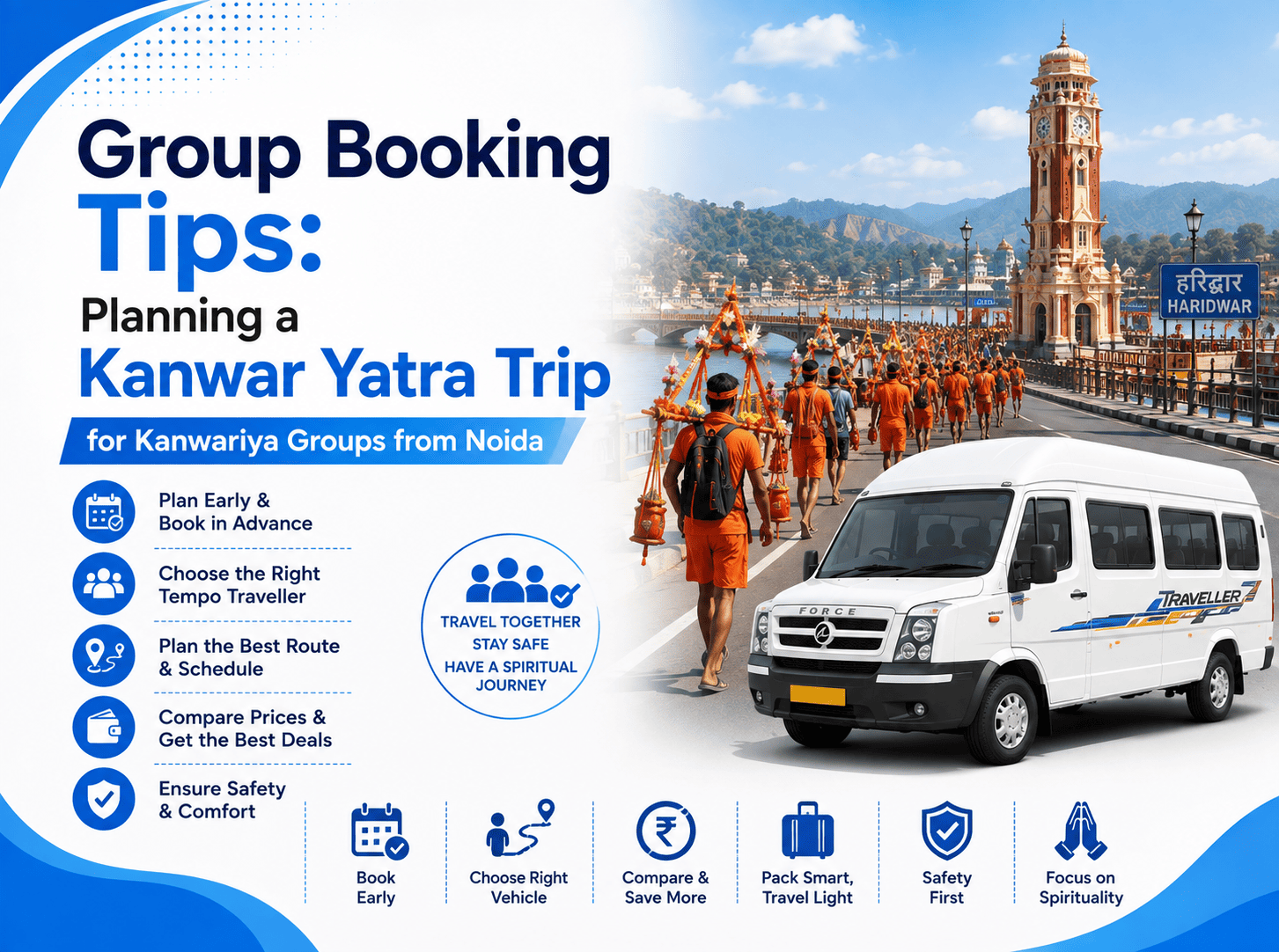
Organizing a Kanwar Yatra trip for a full Kanwariya group is a different task altogether compared to booking a simple family outing.
There’s the group itself to coordinate – sometimes 15, sometimes 40 or more people – along with support vehicles, camp logistics, budget splitting, and the practical reality of managing everyone safely through some of the busiest roads in North India.
If you’re organizing a Kanwariya group trip from Noida this Sawan, this guide walks through the planning details that actually matter, based on how these trips typically play out on the ground.
Start With a Clear Headcount and Group Structure
Every planning decision that follows – vehicle size, budget, camp arrangements – depends on getting your numbers right first.
Confirm your final headcount early, ideally two to three weeks before departure, since numbers tend to shift as people confirm or drop out closer to the date.
Identify who’s walking and who’s supporting. Many Kanwariya groups include both the Kanwariyas themselves, who walk carrying the Kanwar, and a support group travelling by vehicle with supplies, food, and rest arrangements.
Assign one or two group coordinators. Having a single point of contact for transport bookings, payments, and day-to-day coordination avoids confusion when multiple people are messaging different vendors separately.
Create a simple group list with names, contact numbers, and any specific needs (medical conditions, dietary restrictions, elderly members) so this information is available quickly if needed during the trip.
Choosing the Right Vehicle Setup for Your Group
Kanwariya groups usually need more than a single passenger vehicle, since the trip involves both people and supplies.
Passenger vehicle for the support group: A 12 to 25-seater Tempo Traveller, depending on your group size, works well for the support team, elderly members, and anyone not walking the full route.
Separate support vehicle for supplies, if needed: Larger groups often carry tents, cooking supplies, extra water, and rest materials for the walking Kanwariyas – a smaller additional vehicle or a tempo traveller in Noida with extra luggage space can handle this.
Matching seater to actual group size: As a rough guide, 8-10 people suit a 12-seater, 11-14 people suit a 16-seater, 15-17 suit an 18-seater, 18-20 suit a 20-seater, and 21-25 suit a 25-seater. Booking slightly above your tightest headcount, rather than at the exact fit, keeps the journey more comfortable.
AC vehicles for the support team: Since Sawan falls during peak heat and monsoon humidity, an AC vehicle for the non-walking members of your group is worth the modest extra cost, especially for older members or young children travelling with the group.
Budgeting and Cost-Sharing for a Group Trip
Money conversations are often the most awkward part of organizing a group trip, but sorting them out early prevents friction later.
Get a full cost breakdown from your transport operator, including base fare, driver allowance, tolls, and any halt charges, rather than a single vague total.
Decide on a per-head contribution early, based on the total vehicle cost plus estimated food, camp, and offering expenses, and communicate this clearly to the whole group before departure.
Build in a small buffer, typically 10-15% above your estimated budget, to cover unexpected costs like extra fuel for diversions, additional food stops, or minor emergencies.
Keep a designated group treasurer who collects contributions and handles payments, rather than splitting every expense individually on the road, which gets confusing fast with a large group.
Confirm advance payment terms with your vehicle operator, since most operators require a partial advance to confirm a booking, especially during peak Kanwar season when demand is high.
Planning the Route and Camp Stops
Kanwariya groups typically move differently from a standard tourist trip, since walking members set the overall pace.
Plan your support vehicle’s route around official diversions. As covered in our detailed traffic diversion guide, sections of the Delhi-Haridwar highway are reserved for walking Kanwariyas this year (Aug 4-12), so your support vehicle will need to follow the officially diverted route rather than travelling directly alongside walkers.
Identify official camp and rest points along the way. Authorities set up food, prasadi, and health camps at roughly 15-20 km intervals along major routes – knowing these locations helps you plan realistic rest stops for your group.
Coordinate meeting points between walking and vehicle groups. If your group has both walkers and a support vehicle, agree on clear meeting points and rough timings in advance, since mobile network congestion in crowded areas can make last-minute coordination difficult.
Build in buffer time generously. Walking groups move at a different pace than vehicles, and traffic diversions can add hours to a normally short vehicle journey, so avoid tight scheduling around fixed events.
Safety Planning for Larger Groups
Larger groups moving through dense crowds need a slightly more deliberate approach to safety than a small family trip.
Share emergency contacts widely within the group, including the driver’s number, a designated coordinator’s number, and local emergency services, so anyone in the group can reach help quickly if separated.
Agree on a simple check-in system, such as a WhatsApp group with periodic location or status updates, especially useful given how large and spread out Kanwariya crowds can get.
Identify vulnerable group members in advance – elderly people, young children, or anyone with health conditions – and plan their seating and rest stops accordingly rather than leaving it to be figured out mid-journey.
Carry a basic group first-aid kit, along with any personal medication needs flagged in advance by group members.
Stay aware of official security measures. This year’s Yatra includes drone surveillance and CCTV monitoring across sensitive zones, along with a heavier police presence near Har Ki Pauri and major highway stretches – a good reason to follow official instructions from personnel on the ground rather than trying to navigate around them.
Coordinating Communication Within the Group
Communication breaks down fastest in large groups, especially in crowded areas with patchy network coverage.
Set up a dedicated group chat before departure, used specifically for trip coordination rather than mixed with regular social messaging.
Share the full itinerary in writing with the whole group in advance, including pickup times, route plan, camp stops, and expected return time.
Designate sub-group leaders if your group is large (25+), so smaller clusters within the trip have someone to check in with directly rather than everything routing through a single coordinator.
Plan for low-network zones. Certain stretches near Haridwar and along the highway see heavy network congestion during peak Yatra days due to sheer crowd density – agree on a fallback meeting point in case calls or messages don’t go through.
What’s Different About This Year’s Group Planning
A few 2026-specific details are worth building directly into your group’s plan.
The Aug 4-12 vehicle-free corridor on the Delhi-Haridwar highway means support vehicles need a confirmed alternate route, which your transport operator should already be tracking closely.
DJ and sound restrictions – a maximum of 10 feet height and 12 feet width for DJ setups and Kanwars, with sound capped below 75 decibels and only religious songs permitted – apply directly to groups travelling with music systems, so confirm your setup complies before departure.
Increased checkpoint density along the route means groups should expect brief stops for checks, particularly around Meerut and Muzaffarnagar, and should carry basic ID for all members.
Relief camp availability at 15-20 km intervals is genuinely useful for larger groups needing food, water, or rest, so it’s worth mapping these into your plan rather than relying solely on your own supplies.
Booking Your Group’s Tempo Traveller: A Quick Recap
Since transport is usually the first thing to lock in, a few reminders specific to group bookings are worth repeating here.
Book early – ideally one to two weeks ahead, since larger seaters get booked out fast during peak Yatra week.
Confirm seater size against your actual headcount, not a rough estimate, to avoid last-minute overcrowding or unused capacity.
Get your pickup point, timing, and full fare breakdown in writing before the trip, so there’s no ambiguity for a large group on travel day.
Ask about the driver’s familiarity with current diversions, since this matters even more for a support vehicle trying to stay in sync with a walking group.
Reconfirm two or three days before departure, since traffic advisories and diversions can shift with little notice as the Yatra progresses.
A Sample Day Plan for a Support Group Trip
While every group’s plan looks a little different, having a rough timeline helps set expectations before departure.
Early morning (4:30-5:30 AM): Departure from Noida, ideally before daytime traffic and Kanwariya movement peaks on the highway.
Mid-morning: First rest stop, often coinciding with a relief camp along the route, for breakfast and a headcount check.
Midday: Continued travel through the Ghaziabad-Meerut-Muzaffarnagar stretch, where the support vehicle should expect the diversions covered earlier in this guide.
Afternoon: Arrival in the Haridwar area, coordination with walking group members if they’re arriving separately, and settling into camp or accommodation.
Evening: Group darshan at Har Ki Pauri, Ganga Aarti, and Ganga water collection for those completing this leg of the Yatra.
Return journey: Timed either the same evening for a quick turnaround or the next morning, depending on whether your group is doing a Dak Kanwar (fast return) or a more paced trip.
This is only a rough template – actual timing should be adjusted based on your group’s specific plan, whether members are walking part of the route, and the latest traffic advisories on your travel date.
Choosing a Transport Operator You Can Rely On
For a group trip of this scale, the transport operator matters as much as the vehicle itself.
Ask about their experience with Kanwar season bookings specifically, not just general outstation trips, since this season has its own logistics that a generalist operator may not be familiar with.
Check if they can provide multiple vehicles if needed, in case your group requires both a passenger vehicle and a separate supply vehicle.
Confirm they track daily traffic advisories, since an operator who proactively adjusts routes based on the latest diversions saves your group significant time and stress.
Look for clear, written communication, including fare breakdowns, pickup confirmations, and driver details, rather than vague verbal assurances, especially important when a group treasurer is coordinating payment on behalf of many people.
Book Your Group’s Tempo Traveller for Kanwar Yatra 2026
At Manvi Tempo Traveller, we regularly work with Kanwariya groups, community organizations, and family circles travelling from Noida and Noida Extension to Haridwar during Sawan.
We offer 9 to 25-seater AC and non-AC Tempo Travellers, with experienced drivers who track this year’s diversions, checkpoint locations, and the fastest available routes closely, so your support vehicle stays coordinated with your group’s plan.
👉 Explore our dedicated Noida to Haridwar Tempo Traveller service for route details and group booking.
📞 Call us at +91 7428220889 or book your Tempo Traveller now to plan your Kanwariya group’s trip this season.
Frequently Asked Questions
1. How far in advance should a Kanwariya group book transport from Noida?
At least one to two weeks in advance is recommended, since demand for tempo travellers rises sharply during peak Kanwar Yatra week.
2. What size vehicle is best for a Kanwariya support group?
It depends on headcount – 12-seaters suit 8-10 people, while 20 and 25-seaters suit larger groups of 18-25, with slightly more capacity than your exact headcount recommended for comfort.
3. How should a group split costs for a Kanwar Yatra trip?
Get a full fare breakdown from your operator (base fare, tolls, driver allowance, halt charges), then divide the total plus estimated food and camp costs across the group, with a 10-15% buffer for unexpected expenses.
4. Can a support vehicle travel alongside walking Kanwariyas on the highway?
Not directly during restricted periods – this year, a section of the Delhi-Haridwar highway is reserved exclusively for walking Kanwariyas from August 4 to 12, so support vehicles need to follow official diverted routes.
5. What safety steps should a large group take during Kanwar Yatra?
Share emergency contacts widely, set up a group check-in system, identify vulnerable members in advance, and carry a basic first-aid kit for the trip.
6. Are there rules about DJs and music for Kanwariya groups this year?
Yes, DJ setups and Kanwar structures are capped at 10 feet height and 12 feet width, with sound levels restricted to below 75 decibels, and only religious songs permitted.
7. What if group members get separated during the Yatra due to crowd density?
Agree on a fallback meeting point in advance and share the driver’s and coordinator’s direct numbers widely within the group, since network congestion is common in crowded areas near Haridwar.