


Haridwar turns into one of the busiest religious destinations in the country every Sawan. Crores of Kanwariyas converge on the city to collect sacred Ganga water, and the roads leading in and out of Haridwar go through some of the heaviest traffic management of the year.
If you’re planning a trip to Haridwar during Kanwar Yatra 2026 – whether for the pilgrimage itself, or simply to visit Har Ki Pauri with your family – knowing the exact dates, the current traffic diversions, and the smartest way to reach the city will save you hours of confusion on the road.
Kanwar Yatra 2026: Full Dates at a Glance
The Kanwar Yatra 2026 began on July 30, the first day of the holy month of Sawan.
It continues through Sawan Shivratri on August 11, with the Jalabhishek ritual – offering Ganga water to Lord Shiva – typically performed in the early hours of August 12.
The final stretch of the Yatra, roughly August 4 to August 11, is when Haridwar sees its heaviest footfall.
This is also the window when the strictest traffic restrictions are in force across Uttar Pradesh, Uttarakhand, and Delhi-NCR.
If your travel dates fall within this period, you should treat your trip planning differently than a normal outstation visit to Haridwar.
Why This Year’s Traffic Management Looks Different
Every year, the scale of the Kanwar Yatra grows, and so does the coordination required between Uttarakhand, Uttar Pradesh, Delhi, and Haryana police.
This year, officials have gone further than usual with dedicated vehicle-free corridors, expanded drone surveillance, and tighter sound restrictions – all worth knowing before you set out.
1. Delhi-Haridwar Highway: Vehicle Ban (Aug 4-12)
The single biggest update for 2026 is a complete vehicle ban on sections of the Delhi-Haridwar highway from August 4 to August 12.
A dedicated stretch of the national highway has been reserved exclusively for walking Kanwariyas during this period.
Heavy vehicle movement has already been restricted on this same corridor since July 30, with the full ban kicking in as the crowd peaks closer to Shivratri.
2. Muzaffarnagar and Meerut: The Most Affected Stretch
Muzaffarnagar remains one of the most heavily managed districts during the Yatra, since a large share of Kanwariyas pass directly through it on the way to and from Haridwar.
Local police have divided the district into multiple zones and sectors purely for crowd and traffic control.
Over a thousand CCTV cameras have been installed along the route in this belt alone, in addition to temporary police posts set up specifically to assist pilgrims.
Meerut sees similar diversions, particularly around the Delhi-Meerut corridor, where daytime traffic is routinely rerouted away from the main pedestrian flow.
3. DJ, Sound, and Kanwar Structure Rules
Sound and structure regulations are being strictly enforced this year.
DJ setups and Kanwar structures are capped at a maximum of 10 feet in height and 12 feet in width.
Sound levels must stay below 75 decibels, and only religious songs – bhajans and Shiv bhajans – are permitted to be played.
Police have been directed to take action, including FIRs, against anyone violating these limits or attempting to force entry into restricted lanes.
4. Drone Surveillance and Control Rooms
Drones are being deployed across sensitive zones, including Har Ki Pauri, key highway stretches, and rest camps.
This footage feeds into centralized control rooms for real-time monitoring.
The goal is faster response to congestion, medical emergencies, or security concerns across such a large and spread-out crowd.
5. Relief Camps, Food, and Health Support
State administrations have directed officials to set up food and prasadi camps at intervals of roughly 15 to 20 kilometres along the major routes.
These are paired with health camps, ambulances, and drinking water points, positioned every few kilometres in high-footfall zones.
Many local shops along the route also temporarily close meat and liquor sales during the Yatra period, in line with directions from local authorities.
Traffic Diversions: State-by-State Snapshot
Since the Yatra spans multiple states, diversions look a little different depending on where you’re coming from.
Delhi: Delhi Traffic Police typically diverts heavy commercial vehicles away from routes used by Kanwariyas entering or crossing the city, particularly around GT Karnal Road, Wazirabad Road, and the Outer Ring Road.
Motorists are advised to plan alternate routes well ahead of time rather than adjusting on the fly.
Uttar Pradesh (Ghaziabad, Meerut, Muzaffarnagar): This stretch carries the heaviest pedestrian Kanwariya traffic of the entire route from NCR to Haridwar.
Expect phased restrictions that tighten as the date gets closer to Shivratri, with one side of the highway often reserved entirely for walking pilgrims.
Uttarakhand (Roorkee, Haridwar): This is the receiving end of the Yatra, where crowd density is highest.
Expect city-wide traffic management around Har Ki Pauri, additional one-way systems, and vehicle entry restrictions closer to the ghats during peak hours.
Haryana and Rajasthan: Groups travelling via these states face lighter but still noticeable diversions, mainly around towns that see a secondary flow of Kanwariyas heading toward their home temples after Haridwar.
How to Reach Haridwar from Noida: Comparing Your Options
There are a few realistic ways to reach Haridwar during Kanwar season. Each comes with its own trade-offs.
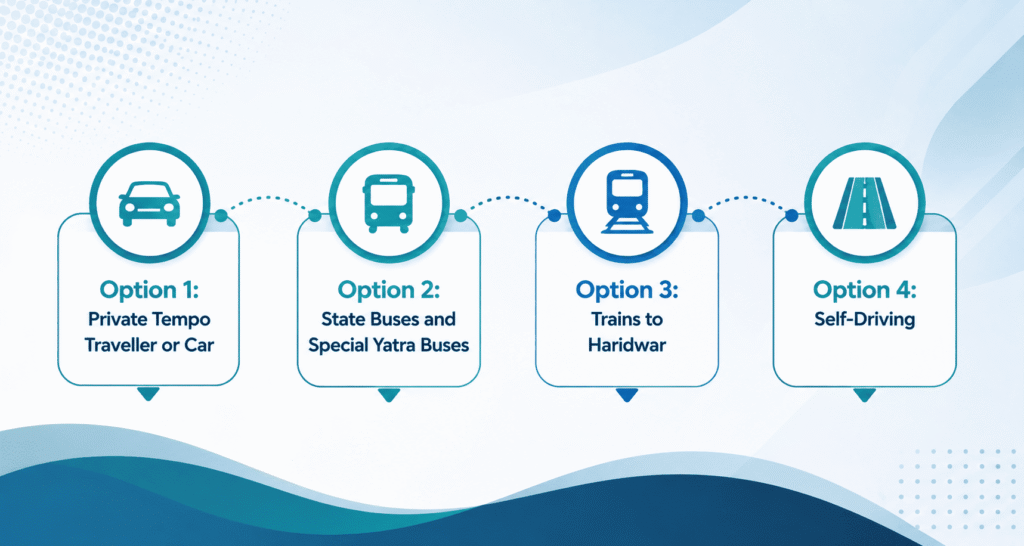
Option 1: Private Tempo Traveller or Car
This remains the most flexible option for families and groups.
You control your departure time, your stops, and your route – which matters enormously when highway conditions can change within hours.
A private vehicle and tempo traveller from Noida also means your entire group travels together, without the risk of getting split across buses or train coaches during a crowded season.
The trade-off is that you still need a driver who knows the current diversions well, since navigating unfamiliar detours around Muzaffarnagar or Meerut without local knowledge can cost you real time.
Option 2: State Buses and Special Yatra Buses
Many state transport corporations run special buses during the Yatra season, and these can be a budget-friendly option for solo travellers or very small groups.
However, buses follow fixed routes and timings, which offer little flexibility if diversions change mid-journey.
Seating during peak days can also be extremely limited, since demand spikes sharply in the final week before Shivratri.
Option 3: Trains to Haridwar
Trains to Haridwar run through Roorkee and connect from Delhi and nearby NCR stations.
This can be a reasonable option outside the absolute peak days, but ticket availability drops fast as the Yatra progresses, and stations themselves get extremely crowded closer to Shivratri.
Option 4: Self-Driving
Some families prefer to drive themselves, especially if they already know the route well.
This works reasonably outside the restricted corridor, but during the Aug 4-12 vehicle-free window, self-driven vehicles face the same diversions as any other private vehicle, with no special exemption.
How to Book a Tempo Traveller During Kanwar Yatra 2026
Booking a tempo traveller during this season works a little differently than a regular outstation booking, mainly because demand spikes so sharply in the final week before Shivratri.
Here’s how to go about it properly.
Step 1: Book early, not at the last minute. Vehicles for the Noida-Haridwar route get booked out fast once the peak days approach. Ideally, confirm your vehicle at least one to two weeks before your travel date, especially if you’re travelling within the Aug 4-11 window.
Step 2: Decide your group size and seater first. Tempo travellers typically come in 9, 12, 16, 18, 20, and 25-seater configurations. Counting your group accurately – including anyone joining midway or dropping off early – helps you book the right size instead of overpaying for empty seats or running short on space.
Step 3: Choose AC or non-AC based on your travel window. Since the Yatra falls in Sawan (July-August), AC vehicles are worth the small extra cost for a five-to-six-hour-plus journey, particularly for family groups with elderly members or children.
Step 4: Confirm the driver’s route familiarity. Ask directly whether the driver is experienced with the current year’s diversions around Ghaziabad, Meerut, and Muzaffarnagar. A driver who only knows the “normal” route can lose significant time navigating unfamiliar detours during peak season.
Step 5: Get your pickup point, timing, and total fare confirmed in writing. A simple WhatsApp or email confirmation with pickup location, departure time, vehicle number, and total cost avoids confusion on travel day, especially with early morning departures.
Step 6: Ask about waiting charges and halt policy. Since Kanwar season involves stops for darshan, food camps, and possible traffic delays, clarify in advance whether waiting time and overnight halts (if any) are included in the quoted fare.
Step 7: Reconfirm one or two days before travel. Given how quickly official traffic advisories can change during this period, a quick reconfirmation call closer to your travel date ensures your operator is still planning around the latest route information.
Step 8: Keep a direct contact number for the driver. Having the driver’s number saved (not just the booking office) makes it much easier to coordinate last-minute pickup changes or delays on the actual day.
At Manvi Tempo Traveller, we handle all of this directly with you when you call or message us – confirming seater, AC preference, route plan, and total fare upfront, so there are no surprises once you’re on the road.
How to Book a Train to Kanwar Yatra 2026
If you’re planning to reach Haridwar by train instead of road, a bit of early planning goes a long way, since ticket demand rises sharply through the Yatra period.
Step 1: Identify the right station. Haridwar Junction is the main station serving the Yatra. Roorkee is a useful alternate station if Haridwar-bound trains are full, since it’s a short distance further from the main ghats.
Step 2: Book through IRCTC well in advance. Regular ticket booking opens up to 120 days before the journey date on the IRCTC website or app. For Kanwar season specifically, booking as early as this window allows is strongly recommended, since confirmed seats become scarce fast.
Step 3: Check for special Yatra trains. Indian Railways typically runs additional special trains during the Kanwar Yatra period to handle the surge in demand. These are usually announced closer to the season, so checking IRCTC’s special trains section or your nearest station’s notice board in the weeks before travel is worth doing.
Step 4: Consider Tatkal booking if regular tickets are unavailable. Tatkal booking opens one day before the journey (10 AM for AC classes, 11 AM for non-AC) and can be a fallback option if advance booking didn’t come through, though availability is not guaranteed during peak Yatra days.
Step 5: Keep a flexible date range in mind. If your travel dates can shift by a day or two, checking availability across a small date range rather than a single fixed day significantly improves your chances of getting a confirmed seat.
Step 6: Plan your onward journey from the station. Since stations get crowded quickly during peak Yatra days, arrange your onward local transport (to Har Ki Pauri or your hotel) in advance rather than expecting to find one easily on arrival.
Step 7: Carry printed or downloaded tickets and ID proof. With heavy checking and crowd management in place during this period, having your ticket and ID readily accessible (rather than searching for them in a crowded compartment) makes the process smoother.
Step 8: Build in extra time for delays. Train schedules can see minor delays during the Yatra period due to the sheer volume of passenger movement through these stations, so avoid booking connecting travel with very tight timing right after arrival.
If train availability doesn’t work out for your dates – which is common during the peak week – a private tempo traveller booked in advance remains the most reliable fallback, since it isn’t dependent on ticket inventory at all.
Which Option Makes the Most Sense This Year?
For most Noida-based families, corporate groups, and Kanwariya support groups, a private Tempo Traveller with an experienced local driver tends to be the most practical choice this season.
It combines the flexibility of a private vehicle with enough seating capacity for a full family or group, without the unpredictability of shared public transport during peak crowd days.
If your trip falls within the Aug 4-12 window, booking early and confirming your route with your operator becomes even more important, since diversions can change with very little notice.
Best Time to Travel This Season
If your schedule allows some flexibility, a few timing choices can make a real difference to how smooth your trip feels.
Early morning departures – ideally before 5 AM – help you clear the busier Ghaziabad-Meerut stretch before daytime crowds build up.
Avoiding August 8 to 11 is worth considering if possible, since this is when Haridwar sees its highest single-day footfall ahead of Shivratri.
Travelling after August 12, once the vehicle ban lifts and the bulk of the walking pilgrims have dispersed, is a good option if your visit is for darshan rather than the Yatra itself.
Weekdays also tend to be calmer than weekends, when local day-trippers add to the existing Yatra crowd.
A Practical Checklist Before You Leave Noida
A well-planned Kanwar Yatra trip comes down to a handful of practical steps.
Book your vehicle in advance, since demand for tempo travellers spikes sharply during this season, especially for the Aug 4-11 window.
Decide your travel window carefully, factoring in whether you’re travelling for the Yatra itself or simply for darshan afterward.
Confirm your pickup point and departure time clearly with your operator, particularly for early morning starts.
Carry drinking water, snacks, a basic first-aid kit, and comfortable clothing, since parts of the journey may involve extended waits near checkpoints.
Check the latest local traffic advisory for your exact travel date, since diversions can shift day to day during peak Yatra week.
Keep some cash and ID handy for checkpoints, and brief elderly or first-time travellers in your group about expected delays so the journey feels planned rather than stressful.
Respect local guidelines around noise levels and religious sentiment along the route, which keeps the journey smooth for your group and for the Kanwariyas around you.
Har Ki Pauri Access: What Changes During Peak Days
Har Ki Pauri is the heart of the Yatra, and access here changes noticeably once crowds build up.
Vehicles are generally not allowed anywhere close to the ghat itself during peak hours, so plan for a walk from your designated parking or drop-off point.
One-way pedestrian systems are often introduced around the main ghat area to manage the sheer volume of people entering and leaving at the same time.
Timings for the Ganga Aarti may also see minor adjustments during the busiest days, so it helps to check locally on arrival rather than assuming a fixed schedule.
If your group includes elderly members or young children, arriving a little earlier than the main crowd – either early morning or slightly before evening Aarti – tends to make the experience far more comfortable.
Common Mistakes Travellers Make During Kanwar Yatra Season
A few avoidable mistakes account for most of the frustration people experience during this trip.
Assuming last year’s route still applies. Diversions are reviewed and adjusted every year based on crowd patterns, so relying on an old route plan can lead you straight into a restricted stretch.
Leaving too late in the day. Even a two-hour delay in departure from Noida can mean hitting the peak of both commuter traffic and Kanwariya movement at the same time.
Not confirming vehicle availability in advance. Tempo traveller demand rises sharply in the days leading up to Shivratri, and walk-in bookings become far harder to secure.
Ignoring local advisories on the day of travel. Traffic plans can shift with very little notice, and what was open the previous day may be restricted by the time you leave.
Underestimating travel time. A journey that normally takes five to six hours can stretch well beyond that during the peak window, so building in a buffer avoids unnecessary stress for your group.
Planning around these five points alone tends to make the difference between a smooth trip and a genuinely frustrating one.
Book Your Tempo Traveller for Kanwar Yatra 2026
At Manvi Tempo Traveller, we regularly support families, corporate groups, and Kanwariya support teams travelling from Noida and Noida Extension to Haridwar during the Kanwar Yatra season.
Our fleet includes 9 to 25-seater AC and non-AC Tempo Travellers, driven by experienced local drivers who stay updated on current diversions, highway restrictions, and the fastest available routes on any given day.
Whether you’re heading to Haridwar for darshan, supporting a Kanwariya group, or planning a family pilgrimage trip, we can help you travel safely and comfortably, with real-time awareness of the latest restrictions on your travel date.
👉 Explore our dedicated Noida to Haridwar Tempo Traveller service for route details, seating options, and booking.
📞 Call us at +91 7428220889 or book your Tempo Traveller now to secure your vehicle for this Kanwar Yatra season.
Frequently Asked Questions about Kanwar Yatra 2026 Haridwar
1. What are the Kanwar Yatra 2026 dates?
The Yatra began on July 30, 2026, and continues through Sawan Shivratri on August 11, with Jalabhishek rituals concluding around August 12.
2. Is the Delhi-Haridwar highway closed during Kanwar Yatra 2026?
Yes, a section of the highway is reserved exclusively for walking Kanwariyas from August 4 to August 12, 2026, with regular vehicles diverted to alternate routes.
3. Which stretch sees the heaviest traffic diversions?
The Ghaziabad-Meerut-Muzaffarnagar belt sees the heaviest pedestrian Kanwariya movement and the most significant diversions for regular vehicles.
4. What is the best way to reach Haridwar from Noida during Kanwar Yatra?
A private Tempo Traveller with an experienced local driver offers the most flexibility and group comfort compared to buses or trains during peak crowd days.
5. What are the DJ and sound rules for Kanwar Yatra 2026?
DJ setups and Kanwar structures are capped at 10 feet height and 12 feet width, with sound levels restricted to below 75 decibels, and only religious songs permitted.
6. When is the best time to travel to avoid peak crowds?
Early morning departures, weekday travel, and avoiding August 8-11 help reduce congestion. Travelling after August 12 is another good option for a calmer trip.
7. Are food and rest facilities available along the route?
Yes, food, prasadi, and health camps are set up at 15-20 km intervals along major routes, along with ambulances and drinking water points for pilgrims.