
Picture this. It’s 5 AM. Your group is standing outside your society gate, bags piled up, everyone half-asleep but excited. The vehicle pulls up – and it’s too small. Someone’s stuck holding a bag on their lap for the next six hours. Someone else is squeezed against the window with no legroom. The trip hasn’t even started, and half the group is already uncomfortable.
This happens more often than you’d think. And it almost always comes down to one simple mistake: booking the wrong seating capacity.
Choosing a tempo traveller isn’t just about picking a vehicle – it’s about picking the right size vehicle for your exact group, your luggage, and your journey. Get it right, and every hour of the trip feels easy. Get it wrong, and even a short ride feels endless.
In this guide, we’ll walk you through every seating option available, help you match capacity to your group type, and show you exactly how to avoid the common sizing mistakes that ruin group trips. Whether you’re organizing a family getaway, a wedding convoy, a corporate offsite, or a spiritual yatra, if you’re searching for a Tempo Traveller in Noida, this is the only sizing guide you’ll need before you book.
Why Seating Capacity Deserves More Thought Than You’d Expect
Most people book a tempo traveller the way they’d book a cab – by headcount alone. If there are 12 people, book a 12-seater. Simple, right?
Not quite. Seating capacity isn’t just a number. It affects:
- Comfort on long stretches – a vehicle that’s “technically” big enough can still feel cramped on a 6-hour highway drive
- Luggage space – every seat you fill reduces the boot and overhead space available
- Group dynamics – families travelling with elderly members or small children need different spacing than a group of college friends
- Total trip cost – bigger isn’t always more expensive, and smaller isn’t always cheaper once you factor in comfort and safety
Getting the seating capacity right at the booking stage saves you from awkward mid-trip compromises – like someone giving up their seat, luggage sitting in the aisle, or a driver having to make an unplanned stop to rearrange bags.
Understanding the Full Range of Tempo Traveller Seating Options
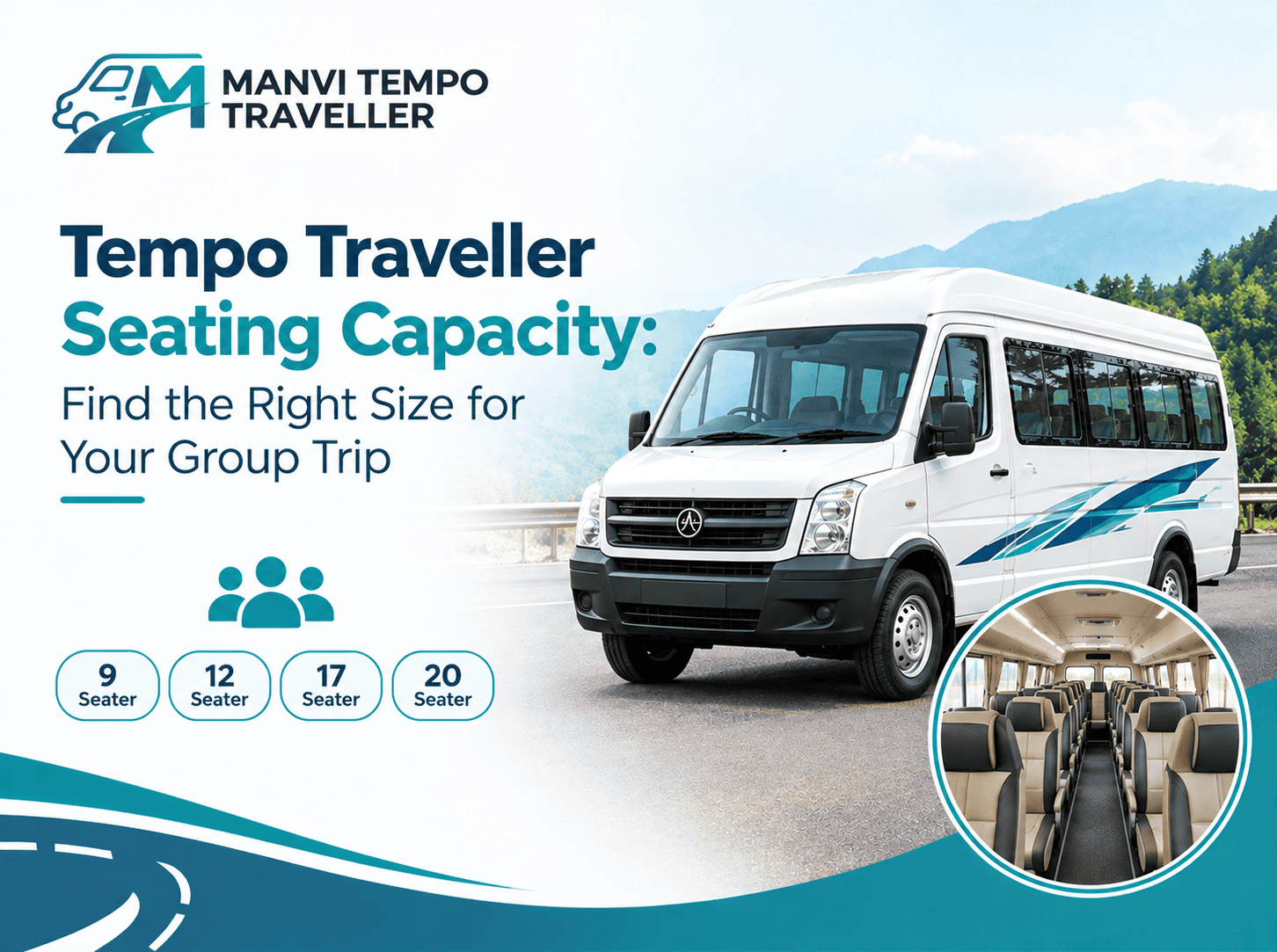
Tempo travellers are built in a wide range of seating configurations, and each one serves a slightly different purpose. Here’s a breakdown of what’s actually available and who each size suits best.
9-Seater Tempo Traveller
The smallest in the tempo traveller family, a 9-seater is ideal for compact groups – a large family, a small friend circle, or a few colleagues heading to a nearby destination. It offers more legroom per person than a regular car or SUV, plus a proper luggage boot, making it a smart upgrade over booking two separate cars.
Best for: Small families, short weekend trips, airport transfers for a mid-sized group.
12-Seater Tempo Traveller
This is one of the most popular sizes for a reason – it hits the sweet spot between compactness and capacity. A 12-seater comfortably fits a joint family or a close-knit group of friends, with enough room left over for suitcases, sports equipment, or wedding gifts.
Best for: Extended family trips, small corporate teams, college friend groups.
14 to 16-Seater Tempo Traveller
Once your group crosses the 12-person mark, a 14 or 16-seater gives you breathing room without jumping to a full-sized bus. These are especially popular for office outings and mid-sized wedding groups where you want everyone travelling together rather than splitting across vehicles.
Best for: Corporate outings, mid-sized wedding parties, group pilgrimages.
17 to 18-Seater Tempo Traveller
At this size, you start getting proper row-by-row spacing with pushback seats, which matters a lot on multi-hour highway journeys. This is a favourite for spiritual tours and outstation trips where the group will be sitting for extended stretches.
Best for: Spiritual yatras, school trips, longer outstation journeys.
20-Seater Tempo Traveller
A 20-seater is where the vehicle starts to feel more like a mini-coach than a van. It’s built for larger, organised groups – think office departments, larger wedding parties, or a full class of students – and usually comes with a bigger luggage compartment to match.
Best for: Large corporate groups, school and college excursions, big family functions.
25-Seater Tempo Traveller
The largest option in the tempo traveller category, a 25-seater is essentially a small coach. It’s the go-to choice for big weddings, large religious group tours like Kanwar Yatra or Char Dham Yatra, and any trip where dozens of people need to move together without splitting into multiple vehicles.
Best for: Large wedding baraats, big spiritual yatra groups, large-scale corporate events.
How to Actually Calculate the Right Seating Capacity
Here’s the part most people get wrong: they count heads and stop there. A smarter approach factors in a few more things.
Step 1: Count Your Actual Group Size
Start with the real number of travellers – not an estimate. If you’re not 100% sure everyone is coming, round up rather than down.
Step 2: Add a Comfort Buffer
If you have exactly 12 people, don’t book a 12-seater. Every seat gets filled with zero breathing room, and there’s nowhere to put a bag, a jacket, or a sleeping child. A good rule of thumb: book one size up from your exact headcount whenever it’s a trip longer than 2–3 hours.
Step 3: Factor In Luggage Type
A family vacation means suitcases. A spiritual yatra means bedding rolls and prasad boxes. A wedding trip means garment bags, gift boxes, and decor material. Heavier or bulkier luggage eats into passenger space fast – size up accordingly.
Step 4: Consider Passenger Profile
A group of young friends can manage a slightly tighter seating arrangement. A group with elderly parents, toddlers, or anyone needing extra space to stretch their legs should always lean toward a bigger vehicle, regardless of headcount.
Step 5: Think About Trip Duration
For a 1-2 hour local trip, a snugger fit is manageable. For a 6+ hour outstation drive, cramped seating turns into real discomfort – and even minor soreness or stiffness by the time you arrive.
Matching Seating Capacity to Your Type of Trip
Different trips have different seating needs, even at the same headcount. Here’s how to think about it by occasion.
Family Trips and Vacations
Families usually travel with more luggage per person than any other group – strollers, extra clothes, snacks, entertainment for kids. For a family of 8-10, a 12-seater usually gives the right balance of space and comfort. Larger joint families should look at the 14-16-seater range.
Wedding Transportation
Weddings are unpredictable – guest counts shift right up to the last day, and there’s always extra baggage in the form of gifts, decor, and outfits. For close family movement, a 12-16-seater works well. For guest transport or full baraats, the 20 or 25-seater range is safer, since undercounting on a wedding day creates real stress.
Corporate Outings and Offsites
Corporate groups value punctuality and comfort equally – nobody wants to arrive at a client meeting or team offsite looking rumpled from a cramped ride. Match the vehicle to your exact team size plus one size up, and always confirm laptop bags and presentation material are accounted for in the luggage estimate.
School and College Trips
Student groups usually travel in larger numbers with a teacher or coordinator supervising. The 17 to 20-seater range is common here, giving enough room for backpacks, sports kits, or project material, while keeping the group together in one or two vehicles rather than scattered across many.
Spiritual and Pilgrimage Tours
Yatra groups – whether for Char Dham, Kanwar Yatra, or a Vaishno Devi trip – often travel long distances over multiple days, sometimes overnight. Comfort matters enormously here, since fatigue affects the entire experience. The 17-seater and above range, with proper legroom and luggage space for bedding and offerings, is the standard recommendation.
Seat Configuration and Layout: What Else to Check
Seating capacity is only half the picture – layout matters just as much.
- Push-back seats: Found in most 12-seater and above configurations, these recline slightly for long journeys and make a noticeable difference on multi-hour drives.
- 2+2 vs 2+1 seating: Wider aisles with 2+2 layouts feel more spacious; 2+1 layouts sometimes squeeze in more capacity but reduce individual comfort.
- Rear sofa-style seating: Common in luxury variants, useful for families wanting a lounge-style back row.
- Overhead and under-seat storage: Matters a lot for smaller carry-items like water bottles, medicines, and personal bags that shouldn’t go in the main boot.
Always ask about the exact configuration before booking, not just the total seat count – two 17-seaters from different operators can feel completely different once you’re inside.
AC vs Non-AC: Does It Change the Seating Math?
AC tempo travellers sometimes have marginally less headroom due to the cooling unit ducts, but modern fleets are built to accommodate this without any real loss in comfort. For NCR weather – especially summer trips or long spiritual yatras during peak season – AC is worth prioritising even if it means adjusting your seating buffer slightly. Non-AC options remain a good, budget-friendly choice for short, cooler-weather trips.
Common Mistakes People Make With Seating Capacity
- Booking exact headcount with zero buffer – leaves no room for last-minute additions or extra luggage.
- Ignoring luggage volume – a “12-seater” trip with 12 large suitcases will feel far more cramped than expected.
- Not confirming seat configuration – assuming all vehicles of the same size have identical comfort levels.
- Underestimating trip duration’s effect on comfort – what feels fine for an hour can feel very different after four hours.
- Splitting a group across two smaller vehicles unnecessarily – often costs more and complicates coordination compared to one appropriately sized vehicle.
Cost vs Capacity: Finding the Smart Balance
It’s a common myth that a bigger tempo traveller always costs significantly more. In reality, the per-person cost often drops as you move to a larger vehicle, since the base rental is split across more travellers. A slightly bigger vehicle than your bare minimum headcount frequently works out both more comfortable and more cost-effective per person – especially for group bookings on outstation or spiritual tour packages.
Why Getting This Right Matters for Your Whole Trip
The seating capacity you choose shapes the entire tone of your journey. A well-matched vehicle means everyone arrives relaxed, luggage is organised instead of scattered across laps and aisles, and the group can actually enjoy the ride – music, conversation, card games – instead of counting down the kilometres until they can get out and stretch.
This is exactly why, at Manvi Tempo Traveller, every booking starts with a conversation about your group size, luggage, and trip type before we recommend a vehicle – not the other way around. We’ve seen firsthand how the right seating decision transforms a trip from merely functional to genuinely enjoyable, whether it’s a family vacation, a wedding convoy, or a multi-day spiritual yatra from Noida.
Choosing the right size isn’t about picking the biggest or the cheapest option – it’s about picking the one that fits your group’s real needs. Take a few extra minutes to run through your headcount, luggage, and trip length before you book, and the rest of your journey will thank you for it.
Don’t leave your group’s comfort to guesswork. Our team at Manvi Tempo Traveller will help you pick the exact seating capacity for your trip – whether it’s 9 seats or 25 – with clean, well-maintained vehicles and experienced drivers who know every route in and out of Noida.
📞 Call us now at +91 7428220889 or Book Your Tempo Traveller Today and travel with a group size that actually fits.
(FAQs) about Tempo Traveller Seating Capacity
1. How many seater tempo traveller do I need for a group of 15?
For a group of 15, a 17-seater is usually the ideal choice. It gives every passenger comfortable space, plus room for luggage, without forcing the entire vehicle to run at full capacity.
2. What is the difference between a 12-seater and a 17-seater tempo traveller?
Beyond the seat count, a 17-seater typically offers more luggage space, wider aisles, and better legroom for long journeys, while a 12-seater is more compact and better suited to shorter trips or smaller families.
3. Which tempo traveller size is best for a wedding?
It depends on the group. Close family movement usually works well with a 12-16-seater, while full guest transport or a wedding baraat is better handled with a 20 or 25-seater to avoid last-minute headcount issues.
4. Is a 9-seater tempo traveller comfortable for long trips?
Yes, a 9-seater is comfortable for small groups even on longer trips, as long as luggage is kept reasonable. For journeys over 5-6 hours with heavy luggage, consider a 12-seater instead for extra space.
5. How much luggage space does a 25-seater tempo traveller have?
A 25-seater typically has the largest luggage capacity in the tempo traveller range, generally enough for large suitcases, bedding rolls, and event material for a big group, though exact capacity can vary by vehicle.
6. Should I always book one size bigger than my group’s headcount?
For any trip longer than 2-3 hours, yes – booking one size up gives passengers room to stretch, keeps luggage organised, and comfortably accommodates any last-minute additions to the group.
7. Does seating capacity affect the price of a tempo traveller rental?
Yes, but not always proportionally. Larger vehicles often work out to a lower cost per person, especially for group bookings, making them a smart choice even for groups slightly smaller than the vehicle’s full capacity.
8. What size tempo traveller is best for a spiritual yatra like Char Dham or Kanwar Yatra?
For multi-day pilgrimage trips, a 17-seater or larger is recommended, since these journeys involve long hours on the road plus extra luggage like bedding and offerings, making comfort and space especially important.